
Secrets of Lactate Course
Available online - Click for details
Lactate Threshold Discussion - Part 1
The following chart starts our discussion of the lactate threshold(LT)
We start with four cyclists with wildly different lactate thresholds, here measured in watts. You will also notice that there are wide differences in VO2 max.
If you want to understand what the threshold is and what causes it, read on. We will revisit these four cyclist later on in this discussion.
You will also learn how to train the threshold in the direction you desire.
| Cyclist | VO2 Max | Lactate Threshold |
|---|---|---|
| ml/kg/min | watts | |
| A | 76.1 | 406 |
| B | 67.5 | 362 |
| C | 70.8 | 315 |
| D | 61.4 | 257 |
There is a threshold number for each of the cyclists above but what exactly does it mean? Most know that it somehow affects performance and want to change it to make it higher. But we find that few actually know what the Lactate Threshold is even though they have heard the term many times. The more interesting thing is that few who claim to understand the concept actually know what causes it. One reason is that there is no one accepted definition of it. The other is that there is almost no discussion of the causes of the LT in the academic literature.
First, we will define the Lactate Threshold even though we acknowledge that there are several other definitions in the literature. The definition of the lactate threshold we use is the maximum lactate steady state (often called MAXLASS or MLSS). This is:
- the maximal speed or effort that an athlete can maintain for an extended period and still have little or no increase in lactate. This extended period of time can be as much as an hour or possibly longer.
- At this speed or effort, lactate levels in the blood remain relatively constant which is how the name maximum lactate steady state arose. (Originally this phenomenon was called just the Maximum Steady State but the term lactate was added to emphasize that this marker was key in both the measurement of it and to explain what was causing this effort level to be the maximum steady state.)
- Any increase in effort or speed above this level will cause lactate to increase steadily. It will also force the athlete to either stop or slow down.
- Something is happening physiologically to cause this to happen and we will see this process affects performance.
- Originally it was thought that lactate accumulation was the problem but we now know that lactate was not the issue but the problem was due to the accumulation of other metabolites that accompany the increase in lactate.
Lactate Threshold (LT) - This term has many other definitions than the one above. People argue with each other as to what is the correct way to define it. The answer is that there is no one universally accepted definition. Thus, to make it simple, we use the definition above. We believe this one is best because it represents a physiological phenomenon that is both related to lactate and is important for endurance performance. These other definitions of the lactate threshold are discussed at various places in this course.
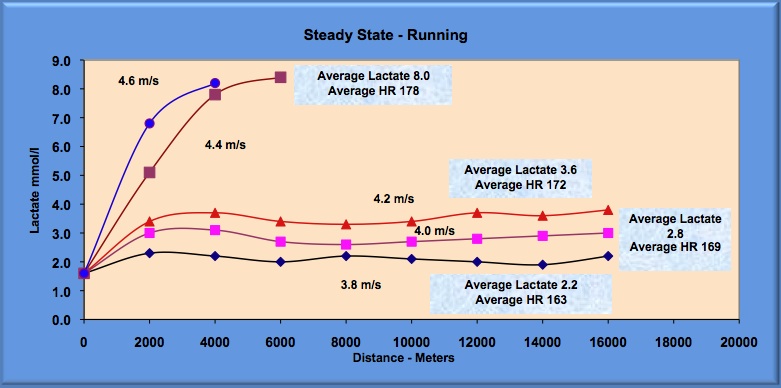
The chart below illustrates the LT: At small effort levels above the LT the athlete's lactate level will rise, and he or she will be forced to stop, sometimes within a few minutes, sometimes a bit longer. Above this maximal lactate steady state there are no more steady states but an inevitable and frequently rapid progression to exhaustion. This effort level is often called the anaerobic threshold or the onset of blood lactate accumulation (OBLA but we will see that these terms also have other definitions. The chart below shows that for this runner, at a pace of 4.2 m/s the lactate levels remain relatively constant but above 4.2 m/s the lactate is no longer in a steady state and the athlete is forced to stop after a period of time
If you just want to know what we consider the best definition of this concept then one can stop here. If you want to know what causes the lactate threshold and how to train it so that it gets better, then this discussion will answer these questions. To understand it all takes some time but we believe every coach and athlete will profit from this understanding. A proper understanding will make one's training more effective and efficient We first start by examining what leads to a good performance and why the lactate threshold is so important for a good performance. Improving one's performance is what most are interested in. We will then explain why measuring the lactate threshold is not important. If you have read the preceding tutorial chapters you will understand why.
What follows now are some reasons why the lactate threshold is important. For those interested there is a more detailed discussion of thresholds in general and how to train them on this website, and specifics for triathletes in our triathlon section. But first a key correlation. The lactate threshold highly correlates with performance in an endurance race. MLSS correlates about .92 with running time in a 8k race. (The validity of the lactate minimum test for determination of the maximal lactate steady state. Jones, A. M.; Doust, J. H., Med. Sci. Sports Exerc., Vol. 30, No. 8, pp. 1304-1313, 1998)
The MLSS is very hard to measure and thus sports scientists have developed other measures that correlate highly with the MLSS and are much easier to measure. Below are two other studies showing measures that correlate with MLSS and which predict performance in an endurance event.
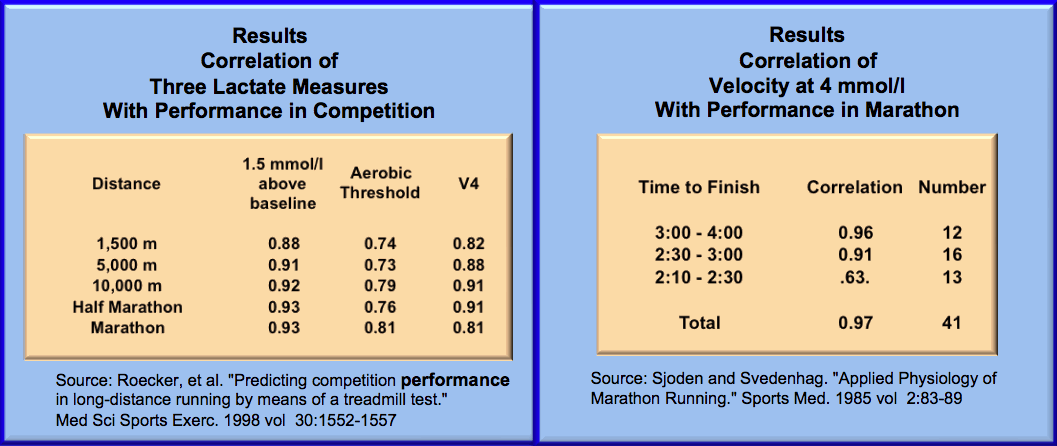
Predicting competition performance in long-distance running by means of a treadmill test Roecker, K.; Schotte, O.; Niess, A.; Horstmann, T.; Dickhuth, H Medicine & Science in Sports & Exercise: October 1998 - Volume 30 - Issue 10 - p 1552-1557
Applied Physiology of Marathon RunningSjödin, Bertil & Svedenhag, Jan Sports medicine 1985 2. 83-99.
In 2009, a review of the Lactate Threshold, listed 25 different LT concepts that had been found in the literature. They also listed 32 studies that investigated the relationship between these LT concepts and performance in endurance events. (Lactate Threshold Concepts - How Valid are They? Faude, O., Kindermann, W. & Meyer, T. Sports Med (2009) 39: 469) This study had 195 references and has been cited by over 700 other studies.
The Lactate Threshold has been called the "gold standard" of athletic performance and has been intensely studied as the Faude study indicates. So there is no doubt that it reliably predicts performance in distance events.
One recent study tried to evaluate various threshold measurements to see which one came closest to actually measuring the MLSS. (Jamnick NA, Botella J, Pyne DB, Bishop DJ (2018) Manipulating graded exercise test variables affects the validity of the lactate threshold and VO2 peak PLoS ONE 13(7))
Interesting no one in these studies questions the need to measure the MLSS or estimate it accurately. They assume that knowing it is the sine qua non of lactate testing. But is it? We will argue that it is not. But finding an easy measure that highly correlates with the MLSS is all that is needed. (All these articles mentioned may be found on the internet through a search engine.)
Since lactate levels are the best indicator of potential race performance for endurance events, frequent lactate threshold testing (every 4-6 weeks) is the best way to find out whether the training program is working or not. For short events such as swimming and rowing the maximal lactate steady state is also correlated with performance but not as much as for distance events. Anaerobic capacity or the ability to produce lactate and speed become more important as the events get shorter.
Each of the terms (lactate threshold, anaerobic threshold, OBLA, V4) are associated with this maximum steady state measure (MLSS). There is even a term called the aerobic threshold, which has appeared in the training literature and is in one of the charts immediately above. See the Roecker study above. The large number of similar terms with different definitions has caused much confusion with both coaches and athletes.
Model of Performance
Researchers have identified two other factors besides the lactate threshold that are highly correlated with performance in endurance sports. These three are
- VO2 max or aerobic capacity
- Economy of Movement
- Lactate Threshold
The chart below depicts this model
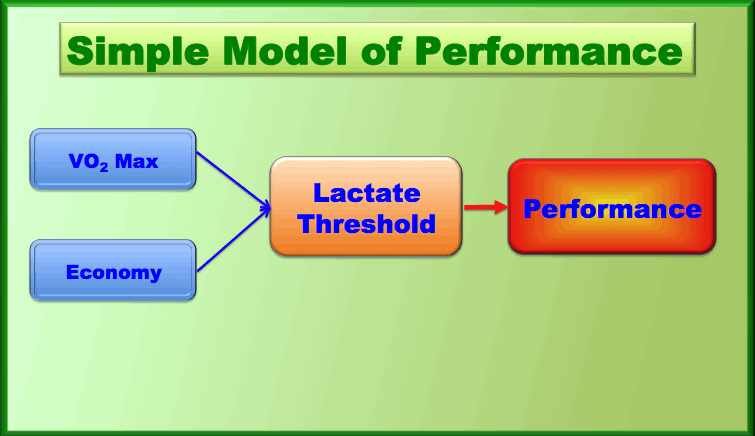
Those who propose this model says that the Lactate Threshold is the most trainable of the three. We believe that all three are trainable to a certain extent and we actually find that most coaches pay more attention to aspects of economy of movement than anything else.
But the more important question is this model correct? Does this model distort what is actually happening? Is it missing something important? Is it conflating one thing with another. First, we believe this model misrepresents what is happening during a competition. Second, we believe there is missing a key factor that determines the effectiveness of training and performance during a race. The next section starts with the conclusion of a extremely good study that hints at what is wrong with this model but does not actually identify what the problem is. It in fact ended up muddying the situation for years instead of clarifying it.