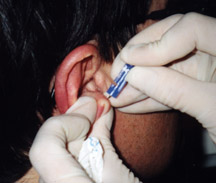
 1. The ear lobe is slightly pierced about 2/3
of an inch from the head on the flat part of the ear lobe and about an eighth of an inch from the edge. After the
ear has been punctured the attendant will wipe the ear with a disinfectant and dry with a sterile pad. The lancet,
the disinfectant pad and the sterile wipe are discarded immediately into a sanitary disposal system.
1. The ear lobe is slightly pierced about 2/3
of an inch from the head on the flat part of the ear lobe and about an eighth of an inch from the edge. After the
ear has been punctured the attendant will wipe the ear with a disinfectant and dry with a sterile pad. The lancet,
the disinfectant pad and the sterile wipe are discarded immediately into a sanitary disposal system.
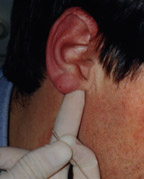 2. Notice a slight red spot where the ear has
been punctured. There will be very little evidence of the spot where the ear has been punctured. The attendant will
place the middle finger at the base of the ear lobe and apply a slight pressure to the area where the ear joins the
head. This will slow the return of blood to the system and help the blood to flow from the puncture when pressure is
applied to the ear lobe near the puncture. The capillary tube will be held between the index finger and the
thumb.
2. Notice a slight red spot where the ear has
been punctured. There will be very little evidence of the spot where the ear has been punctured. The attendant will
place the middle finger at the base of the ear lobe and apply a slight pressure to the area where the ear joins the
head. This will slow the return of blood to the system and help the blood to flow from the puncture when pressure is
applied to the ear lobe near the puncture. The capillary tube will be held between the index finger and the
thumb.
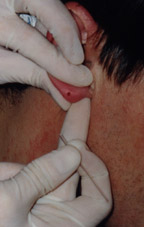 3. While keeping the finger firmly placed at
the base of the ear the attendant will try to shape the ear lobe into a little sac. As this is done gentle pressure
is applied in a downward direction to drive blood toward the puncture spot. A drop of blood will appear at the
puncture spot. It is important that the attendant cleans the first drop of blood each time with a disinfectant and
then dry the ear. This not only ensures sanitary conditions but also removes any old blood that may have been near
the puncture and starting to clot. Thus, there will only be new blood for the test.
3. While keeping the finger firmly placed at
the base of the ear the attendant will try to shape the ear lobe into a little sac. As this is done gentle pressure
is applied in a downward direction to drive blood toward the puncture spot. A drop of blood will appear at the
puncture spot. It is important that the attendant cleans the first drop of blood each time with a disinfectant and
then dry the ear. This not only ensures sanitary conditions but also removes any old blood that may have been near
the puncture and starting to clot. Thus, there will only be new blood for the test.
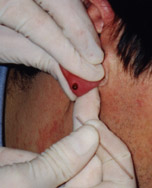 4. As gentle pressure is continually applied
the drop of blood gets bigger. Then the attendant will take a capillary tube and bring it up to the drop of blood.
4. As gentle pressure is continually applied
the drop of blood gets bigger. Then the attendant will take a capillary tube and bring it up to the drop of blood.
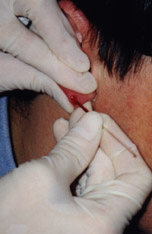 5. When the drop is large enough the
attendant will put the capillary tube on the blood drop. If the attendant is using a system that requires a fixed
amount of blood then they have to be careful not to let air into the tube. They can do this by keeping the capillary
tube pointed up. However for the Accusport portable lactate system, air bubbles are not a problem and the attendant
can take blood without having to worry about the direction of the capillary tube. In this example the capillary tube
is pointed down at a slight angle.
5. When the drop is large enough the
attendant will put the capillary tube on the blood drop. If the attendant is using a system that requires a fixed
amount of blood then they have to be careful not to let air into the tube. They can do this by keeping the capillary
tube pointed up. However for the Accusport portable lactate system, air bubbles are not a problem and the attendant
can take blood without having to worry about the direction of the capillary tube. In this example the capillary tube
is pointed down at a slight angle.
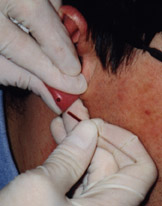 6. The attendant removes the capillary tube
and if there is enough blood in the tube will stop the process.
6. The attendant removes the capillary tube
and if there is enough blood in the tube will stop the process.
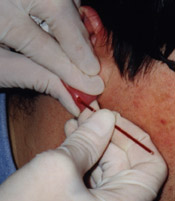 7. If there is not enough blood in the
capillary tube, the attendant will apply additional pressure and take more blood in the capillary tube. At no time
will the attendant squeeze or apply hard pressure to the ear lobe.
7. If there is not enough blood in the
capillary tube, the attendant will apply additional pressure and take more blood in the capillary tube. At no time
will the attendant squeeze or apply hard pressure to the ear lobe.
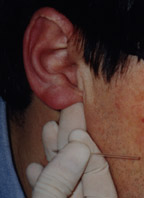 8. After the blood has been taken the area is
wiped and disinfected again. There is very little evidence that there is a puncture and that a blood drop was
present only seconds before.
8. After the blood has been taken the area is
wiped and disinfected again. There is very little evidence that there is a puncture and that a blood drop was
present only seconds before.