

Endurance Events and Lactate Testing
With Emphasis on the Triathlon
What leads to a peak performance in the triathlon? It may surprise you. This page is for LAVA® magazine readers who are interested in optimizing training for the triathlon. If you are using the popular approach that estimates a threshold through a timed test, usually running, cycling or swimming for 30 minutes and then taking an average heart rate or power reading, you are not getting the proper information to train correctly. As you read on, your basic understanding of training will be challenged. Physiological training is mainly training your energy systems. Your energy for each discipline comes from two places, the aerobic and anaerobic systems. So in a way it is just a question of what type of training will change each and in what direction. One of the important parts of the triathlon site is where our four essential principles of training are outlined. These are based on the expereinces of some of the top coaches and sports scientists in the world.
Just knowing a threshold number will not tell you this.
It is not so simple because the two systems interact with each other and this affects performance. Also each workout affects each system in either a positive or negative way. This might sound confusing but we hope this page and the rest of the triathlon section will make this clearer. And when it does, you will train smarter and know best how to increase your three thresholds.
The use of power and heart rates and all the technology that accompanies each of these measures have revolutionized training in a lot of ways. They have improved performance, certainly. But the simplicity of each technology has masked a true understanding of the physiology of energy systems and what makes for optimal training. Consequently training based only on them is missing an essential element.
The ideas of Jan Olbrecht - Are we pulling this out of the air? No, the basis of what we discuss here is in the academic literature and is based on a model of energy metabolism that was developed at the German Sport University Cologne. More importantly it is used in the real world, training world-class athletes. At least one of the top teams in the Tour de France is using it. The specific ideas here are based on the training and testing philosophy of Jan Olbrecht, the training adviser for Luc van Lierde and other world record holders such as Pieter van den Hoogenband who broke the 100 m and 200 m freestyle world records in the Sydney Olympics. They are the ideas that have guided the Dutch rowing team to Olympic medals in the last two Olympics. They have proven themselves in the marketplace of training, generating world class results for events as short as 40 seconds up to ultra-endurance events such as the Ironman.
What is this missing element that we referred to and Olbrecht finds so important? It is the anaerobic energy system. Nearly everyone ignores the anaerobic system for endurance events because they believe that all it does is provide a small amount of energy, roughly about 5% of the total. Why worry about it? They fail to understand that the anaerobic system has two other very important functions in an endurance event.
- First, the anaerobic system determines the lactate threshold
for a specific aerobic capacity. This is how much of your aerobic system you can use. The more the better,
right? That is what everyone is telling you. So you had better pay attention to what is actually controlling
your lactate threshold. When asked what causes the level of your lactate threshold, most exercise
physiologists say it is a mystery. It is no mystery; it is the strength of your anaerobic system relative to
the strength of your aerobic system that determines the lactate threshold.
- Second, the anaerobic system supplies most of the fuel for the aerobic system during a race. If it isn't functioning at the right level the aerobic system will use fats instead of carbohydrates. This is much slower. If the anaerobic system was not operating at all, your race pace would be about 40% slower and your final time would be almost twice as long.
The main function of lactate testing is to measure aerobic endurance. But it also helps the coach and athlete find the impact of the anaerobic system on the threshold. Without this type of testing, it’s all guesswork. Lactate testing is certainly not a cure-all. Like all testing procedures, it has its limitations. But there is no more valuable tool for guiding the training of endurance athletes. This does not say to abandon your power meter or your heart rate monitor. They are valuable too, so use them with lactate testing. But it is lactate testing that reveals what determines how powerfully and how long you can race.
A triathlete completes three separate endurance efforts in one event and thus the information that lactate testing provides is even more relevant. We have placed three ads about the relevance of lactate testing for triathletes in LAVA® magazine. The first ad is below. The others follow.
This first ad indicates that performance on race day depends primarily on how high the speed or power is at the lactate threshold for each of the three disciplines (e.g. 400 m swim time, running speed in meters/s or cycling power.) Performance in a distance event correlates highly with the lactate threshold for that event. Thus, the value of the effort at the threshold will be the best indicator of a subsequent performance. The race pace will be lower than the threshold pace but in general the higher the threshold is the faster the pace an athlete can sustain during a race..

Knowing your power or speed at the threshold is not enough - Even more important than knowing the threshold is knowing what is behind it. Two athletes with identical power at the threshold can have different energy system combinations producing that result and these will require different training approaches to reach a peak performance.
What causes the threshold to be what it is? - It is interesting to know a certain power number or a specific pace that elicits the threshold; it is quite another to know how to make these numbers better. A cookie-cutter approach that uses pretty much the same training workouts for the same threshold power will not get the same results when what is behind the power number is a different combination of the two energy systems. Do you really believe that if two athletes both have a threshold of 275 watts, that they should train identically and if they train identically they will get identical results? Athletes with the same threshold number can be quite different. Yes, they will have similar race results if they were racing that day. But they will not respond to the same training stimulus the same way. If they use the same training program, one may get faster and the other slower. Lactate testing, when used correctly, will ensure that both get better.
So while a TT power reading, a 10k time or a T30 is very useful, it is only a start. - Behind the power reading or running or swimming pace are two energy systems, and each is very important. This is what the coach and athlete should be interested in. It is good to know that an athlete needs "x" watts/kg to finish the bike split in a certain time; it is even better to know what factors are determining how many watts/kg the athlete can generate and how to train these factors to get it higher. And that is what lactate testing is about, training both the energy systems. When you do that correctly, the body will be optimally trained for the event. It is about finding what works for each athlete individually, not treating them all alike.
Thresholds correlate well with performance, with very rare exceptions. Some exceptions are the mini-sprint triathlons, but even here the threshold value is of importance. This does not minimize the value of proper technique, nutrition, hydration, the use of heart rate monitors and power meters and many other factors that affect performance. But the reason a triathlete spends so much time in the pool, on the bike and running has to do with improving all three thresholds and training the energy systems to be correctly balanced. The ad above indicates that many triathletes are unaware of just what their thresholds are. They are even more unaware of the levels of the aerobic and anaerobic systems which determine the thresholds.
Second ad - because the threshold is so highly correlated with performance, lactate testing will tell you if the threshold is progressing in the right direction over time and if it is high enough to get the desired performance on race day. Thus, lactate testing is the best method for evaluating how well an athlete's training is progressing or if there are problems that have to be solved. And by the way just changing the anaerobic capacity alone will change the threshold (this capacity is trainable and how to do this is discussed at other parts of this web site.) You just have to be careful not to change it in the wrong direction.

Third ad - this ad is meant to be provocative. It says that most mistakes in training are made by going too fast. It is difficult to ask an endurance athlete to go slower than a pace that feels very comfortable and easy. But most endurance athletes do not have a built-in warning system that tells them they may be breaking down when they think they are regenerating. Lactate levels will indicate to the athlete that the workout is truly a regenerative effort. One of the modules, primary use of lactate testing, discusses this. This does not say that intense workouts are not valuable. They certainly are, but must be limited because too many can break down too much.

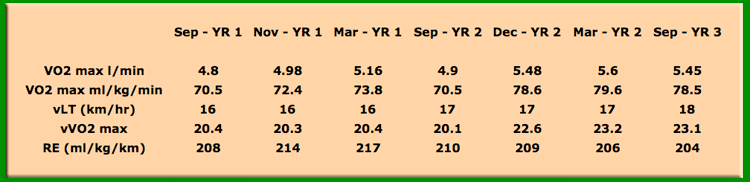
A study was presented at the American Academy of Sports Medicine (ACSM) on June 3, 2011. This study looked at the training of a world class 1500 m runner over a two-year period. The study showed a substantial improvement for this athlete after he increased both the percentage of his low-level training and high-level training. During a two-year period the percentage of training that was less than 80% of vVo2max in year 1 was 20% and in year 2 it was 55%. Also tempo runs in year 2 were at a slower pace than in year 1. From year 1 to 2, there was an increase in the proportion of training in the high intensity zone of 100 to 130% vVo2max from 7 to 10%. Performance changed substantially as the runner's best time in the 1500 m race went from 3:38.9 to 3:32.4 min:s from the beginning of year 1 to the end of year 2 (3:32.94 was the winning time at the Bejing Olympics in 2008.) The next chart showed the changes in VO2max and subsequent running speed, all by training slower. This study is just another confirmation of this training philosophy.
Jan Olbrecht, the trainer of Luc van Lierde when he set his records, has been recommending training at lower speeds for over 20 years. The main reason: training at speeds that the athlete feels are easy and comfortable, may actually be breaking the athlete down instead of regenerating. One of main purposes of training is regeneration but if the pace is too fast, even if it feels easy, then the athlete will break down instead of regenerating. The result will be a slower performance not a faster one. Such an approach does not mean to go too slow or not include any fast workouts. Very fast workouts are extremely good for training but if used too often they break down too much. Also what is slow is relative as a slow pace for an elite triathlete will often be very fast for others. Lactate testing is valuable because over time as the coach monitors the tests he/she will find the right speeds for each athlete.
The rest of the triathlon section is meant to inform and educate the coach and athlete on just what contributes to an optimal performance and in the process illustrate the values of lactate testing and how it can help the athlete reach the desired performance. The site is quite extensive and in fact would provide the material for a small book on the use of lactate testing for the triathlon. It is not meant to be a comprehensive training manual for the triathlon but it covers in detail one of the most important aspects of triathlon preparation, making sure the athlete is optimally trained.
Relationship between Lactate Threshold and Performance
The following chart was developed using the ideas of Jan Olbrecht. Jan was the training adviser to Luc Van Lierde when he set the course record at Kona (October 1996) and completed the fastest Ironman ever until July 2011 (7:50 in Ironman Germany 1997) and when he won again for a second time at Kona in October 1999. This chart indicates how important one measurement, the lactate threshold, is for success in any endurance event and especially the triathlon since it includes three endurance events in one race. One factor that is easily measured will tell triathletes how well they will do in their next race. Measuring it during the training cycle will tell them how well their training is working to reach the desired threshold for the race.
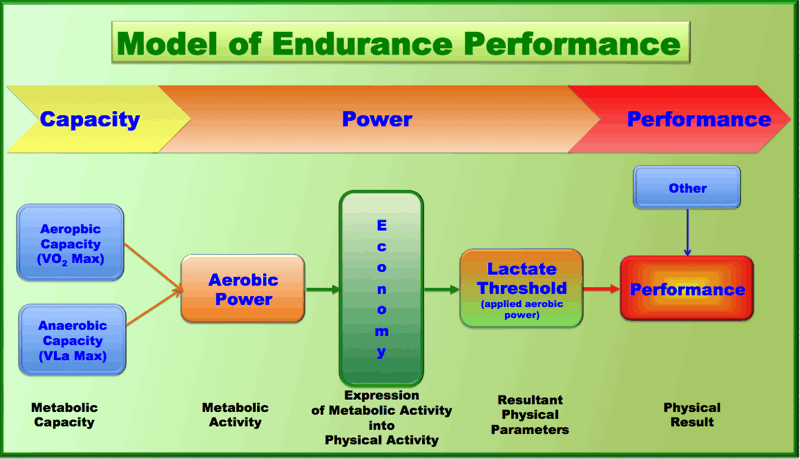
This model is thoroughly explained on our lactate threshold page as each of elements is discussed in detail. For a triathlete, it is essential that he/she optimize the threshold for each of the three disciplines for success in the race. On our two triathlon sites there will be long discussions of what leads to a good performance physiologically in the triathlon. It is what all those training hours and miles are mainly about.
Click here for a brief description of each of the elements that determine the lactate threshold
There are two triathlon sites on this web site. One was started in 2010 and now consists of 19 separate pages on various topics that are relevant to the use of lactate testing for triathletes. The other site was written in 1998 by Jan Olbrecht and reflects his philosophy of testing and training with elite triathletes.
Site 1 - is the more recent of the two sites and is based on Jan Olbrecht's and some other's ideas. The menu on the left will take you to any of the 19 modules in this site. There is a flow to the presentation of the information so reading some out of sequence may miss some ideas presented in earlier sections. Click here for the first page for this site.
Site 2 - written by Jan Olbrecht in 1998 and focuses on elite triathletes. Nothing written then is any less applicable today. Click here for the home page for this site.
Jan Olbrecht recently presented at the First World Conference on Science in the Triathlon in Alicante Spain. Here is a link to his bio on their web site.