
Lactate Testing - Advanced Concepts
Lactate Clearance - What is it?
We have talked about the importance of lactate clearance in the Lactate Physiology and Sports Training sections (See Seção 1 - Terminologia e Conceitos Básicos). During exercise below the lactate threshold, substantial clearance of lactate is happening even as the lactate levels in the blood are rising or in steady state. First, lactate is being cleared or removed from the muscles producing lactate. The rising lactate levels in the blood stream are an indication that a large amount of lactate is leaving or clearing the producing muscles. Second, as lactate travels around the blood stream it is being cleared or removed from the blood by other muscles that are using lactate. Lactate is also being used by other organs such as the liver1.
This usage of lactate by other parts of the body that are not producing it is sometimes referred to as lactate disappearance. The lactate is being used for energy or is being converted into something else. It is hard to observe this disappearance or clearance since blood lactate levels could be rising and it does not look like it is being used anywhere. But it is. The faster the body removes lactate from the blood in these none producing areas of the body, the faster lactate leaves the muscles where it is being produced. Thus, we are using the term "clearance" to describe both lactate removal processes (removal from the producing muscles and removal from the blood stream) and not just the elimination of lactate from the muscles.
The following two charts emphasize that the lactate in the muscle and the lactate in the blood stream are not equal during hard exercise. Over time they tend to reach an equilibrium but in the short term during hard exercise the levels are different. First, a chart to show how lactate accumlates in the muscle and blood stream during a typical step test. Notice two things. First the lactate levels in the muscles (green line) start to increase substantially over the blood lactate levels (yellow line) as the exercise gets harder. Second, at the end of the exercise, the muscle lactate starts to drop off substantially while the blood lactate continues to rise.
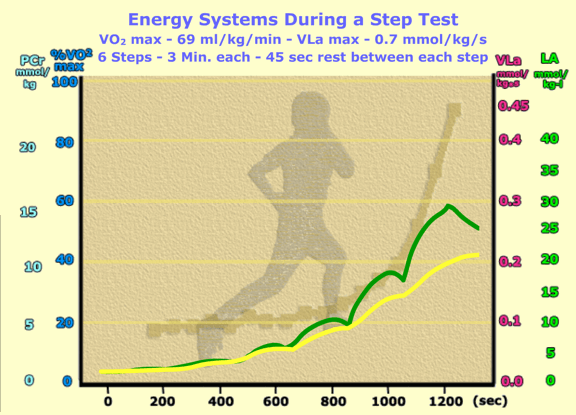
This chart represents a typical step test or graded exercise test. Notice that the blood lactate in green dips a little during the 45 seconds rest between each step. The blood lactate is also affected by this temporary decline as its rise is temporarily slowed down.
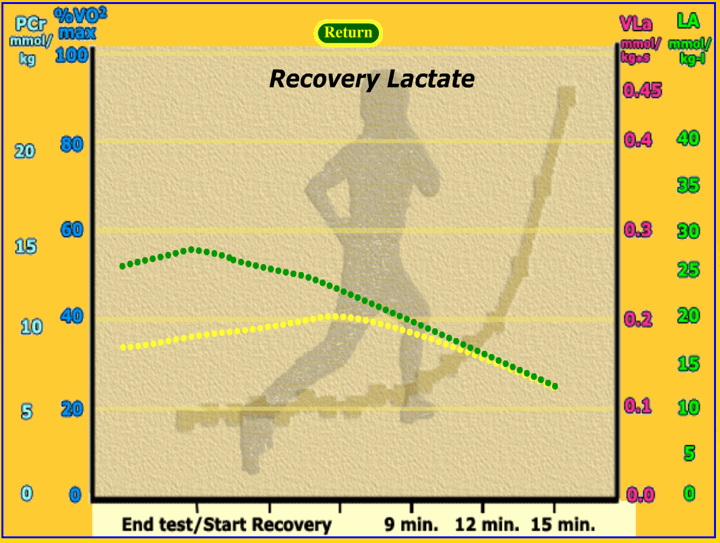
The next chart shows what happens during the recovery phase as the athlete rests. Eventually the two levels come together during the recovery. The rate of decline in both levels will depend upon what is happening at other places in the body.
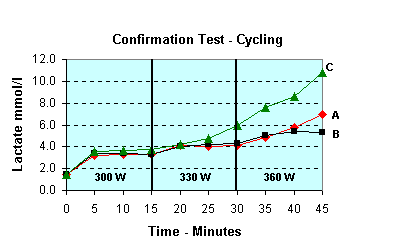
In the Lactate Testing - Basic Concepts section we described a confirmatory test in which three cyclists were able to maintain efforts at 300w without rising lactate levels. The chart of this test is below. Their bodies were removing lactate from the exercising muscles and disposing of it in other areas of the body at the same rate it was being produced. But at 330w, one of the athletes started to build up lactate in the blood. This means that the clearance from the blood was not keeping up with the clearance from the muscles, Lactate was building up in some muscles. Substantial removal and clearance was going on at 330w for this athlete but it was not quick enough to prevent a lactate build-up somewhere. Eventually some of this athlete's muscles will tighten up and shut down.
Recovery Test = An Example of Lactate Clearance
Another term that is often used with clearance is "recovery". Recovery means many things in the training of athletes but in this context it usually refers to the restoration of normal lactate levels in the blood and consequently in the muscles. Different coaches use different standards for recovery. Some will want the athlete to recover to resting lactate levels, while others will want the athlete to reach the lactate threshold or lower but not necessarily resting levels. Because athletes vary substantially in how quickly they can clear lactate, sports scientist have devised recovery tests to measure this capability.
The most common way to conduct a recovery test is to have the body generate a large amount of lactate and then measure how long it takes for the body to lower the blood lactate levels. The athlete will usually recover passively in such a test. It is possible to do this test with an active recovery but this means that the exercise intensity and recovery activity have to be controlled exactly each time in order to compare one test with another.
How the athlete generates the high lactate levels depends on the sport being tested. One way to do this in swimming is to have each athlete complete a simulated 200 m freestyle. The simulation of a 200 m race can be done with a series of four broken 50 m sprints separated by 10 s rest. For other sports a maximal effort protocol could be designed to simulate an actual race in the specific sport. A runner could simulate an 800 m run with a series of 200 m sprints, a rower could perform a 1000 m test on an rowing ergometer and a cyclist could perform a series of sprints on a trainer or cycle ergometer.
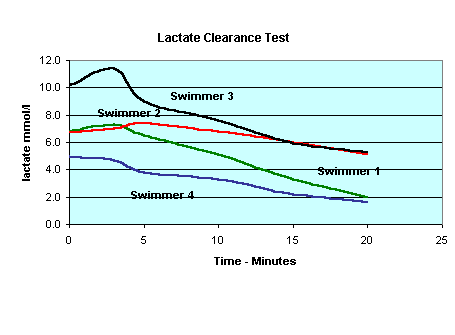
The chart below illustrates a test for elite female swimmers. Each swimmer completed a simulated race and the coach took lactate readings at 3 minutes and 5 minutes to determine the maximal lactate produced during the simulated race. At 10 and 20 minutes the coach took additional lactate readings. After the 20 minute reading, the coach looked for a marked reduction in lactate, usually 40-50%. This could vary by sport and event. Sprinters in swimming and track and field will generally clear less lactate than distance athletes in these sports. Each coach will develop his or her own norms over time. The chart below shows some clearance curves for elite swimmers. Which swimmer won a medal at the Olympics? Which swimmer never made it to Olympic trials? Which swimmer is a distance swimmer? Click here for answer2.
Spot Testing
While coaches have been very interested in measuring lactate production after a maximal effort, many are now more interested in controlling sub-maximal lactate production during training. Spot Testing (or the monitoring of lactate levels during practice) is becoming one of the more important uses of Lactate testing. It is used by coaches
- to confirm the threshold pace,
- to ensure an athlete is not overreaching during a set and generating too much lactate and
- to educate athletes on the feel of certain lactate levels. This latter use helps athletes identify the proper practice paces the coach wants and also helps them with the proper pace during a race.
This use of lactate testing is very important for runners, cyclists and
triathletes as they spend much of their training on roads with uneven surfaces
and frequent hills. It is important for the runner to know just how much
lactate is being generated. Until the introduction of the Accusport, the first portable lactate analyzer, this was
practically impossible. Now there are several very accurate, inexpensive and extremely fast analyzers on the market.
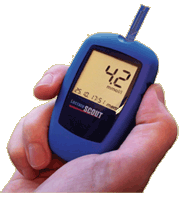
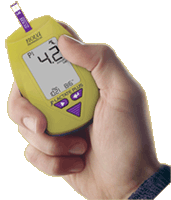
The Lactate Scout provides answers in 10 seconds and the Lactate
Plus provides answers in 13 seconds. Mature athletes can be trained to take their own
lactates at some appropriate spot in their run or ride. This is especially
important since heart rates can drift higher at constant lactate levels for
some runners and the athlete may not be putting enough stress on the
metabolism to get the desired training effect. And then there is the tendency to train too hard and lactate testing
will tell the athlete or coach that the athlete is not pushing too hard. See the long section of triathlon and endurance training on our website and why many endurance
athletes train too hard.
Thus, spot testing is used by coaches not only to make sure the athlete is producing enough stress on the system but also to prevent them from producing too much stress. The following example shows the importance of knowing just what is happening when the athlete is training above the threshold.
Example - Don't fry your athlete
Tom Craig was a coach to several world-class track and swimming athletes and triathletes and used spot testing to monitor his athletes during training. He would take lactate readings throughout the year when he needed to decide how to proceed. The lactate spot test provided a window to look inside an athlete when it is really important, during a training session. Even though Tom used RPE (Rating of Perceived Exertion), and a heart rate monitor as well as the stopwatch, these often do not provide the precise information that he wanted during a training session especially if it is in preparation for a big event.
Tom coached Regina Jacobs, 1995 World indoor champion at 1500 meters, Olympic finalist and silver medal winner at the 1997 World championships in Athens at this event. She was in her last week of a two month base training period. She had four sets of 4 x 200 meters hill repeats to work on her power. Regina had already run a strong threshold workout earlier in the week and had planned a major road race in two days to assess the state of her training.
Tom and Regina had defined three separate anaerobic zones based on her lactate profile developed by an increasing effort test two weeks before. The zones were Light (6-9 mmol/l); Moderate (9-11 mmol/l) and Max (11-14 mmol/l). Regina was to train in the Light zone during the 200 meter hill repeats. After completing the first set, Regina's lactate level was 6.8 mmol/l. After an eight minute recovery jog her lactate was 2.8 mmol/l and she was ready for her next set. Her RPE, heart rate and times were as expected.
The second set of 200's produced a lactate level of 9.2 mmol and the clearance was only 4.5 mmol after 8 minutes. Both readings were higher than desired and Tom began to worry that Regina was training at too high an intensity. The third set produced a lactate level of 10.8 mmol and a clearance of 4.8 mmol. He knew it was time to stop, because he could see the fourth set producing levels of 12-13 mmol, depleting her glycogen and causing excess acidosis which would impair her aerobic capacity. Tom used the expression "Regina would have been fried for the weekend race." It would have taken 96 hours for her to recover fully from excessive training in the max anaerobic zone. It is important to note that her RPE, heart rate and times were normal throughout the second and third sets. Only the lactate readings suggested a problem with recovery. Tom stopped the workout at three sets and Regina went on to record a personal best in the weekend road race.
Regina Jacobs was a world class athlete and most coaches do not have the time to test each runner's recovery after every intense set. However, a spot check strategically planned by a coach will tell him/her just what is going on with runners in some of these high intensity sets. What might be a 5-6 mmol effort level for one runner may be a 9-10 mmol level for another. A coach should be aware of this and, if he/she suspects a problem, can conduct a spot test. If a runner reports extreme fatigue or looks sluggish, a spot test or recovery test will tell whether the problem is physical or motivational. And at the lower end what looks like a recovery or regenerative workout can often be near 3 mmol/l or higher instead at 2 mmol/l or lower because endurance athletes feel little stress at these levels. So what looks comfortalbe to the athlete or coach may actually be breaking down aerobic capacity instead of building it back up. Look at the Assessment part of the section on triathlon training.
Over-Training
Lactate tests can tell if something might be going wrong with your athletes. While there is no clear understanding of just what causes over-training and how to diagnose it, some types of lactate tests can help a coach spot problems. The chart below presents a series of lactate tests that indicate an athlete is having problems. The cyclist in the example had a good training season and performed well at a major competition (See Lactate Testing - Basic Concepts Section). He then continued to train hard. Encouraged by his initial success he increased both the amount and intensity of his training. However, performances began to deteriorate. A lactate profile late in the season showed the following:
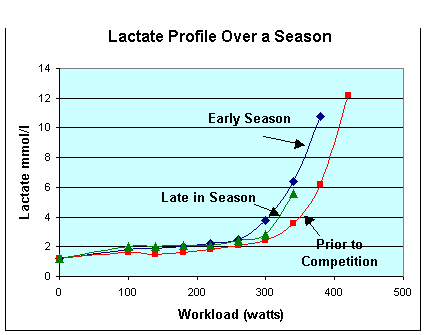
The latest profile indicated that something was wrong. Initial levels of lactate are slightly higher than they have been before the two previous tests. This, by itself, is not a large enough difference to be concerned about. The real issue is that the last reading, which is supposed to be a maximum effort, produces considerably lower lactate than the two prior tests. Also it is at a lower effort level. This indicates a problem, which could be over-training. It could also be glycogen depletion from overly stressful training prior to the test, a temporary illness, or general fatigue. But it suggests that races taking place around the time of the test will probably not be very successful. A coach observing this might rest the athlete, check for additional symptoms of over-training, have him checked by a physician, and try the test again in another week. As a result both the coach and the athlete learned a lot more about how the body responds to training which is by far the main use of lactate testing.
Length of Steps in Graded Exercise Test
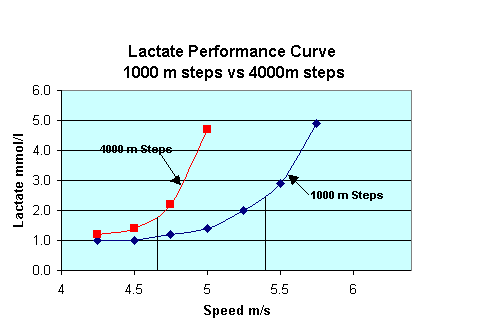
Several coaches and sports physiologists recommend that the steps in a lactate performance curve be much longer than the typical 3-5 minutes, especially for endurance athletes such as triathletes, distance runners and road cyclists. The following example illustrates the potential differences between using short steps and long steps3. A triathlete attempts to estimate his lactate threshold for running by using 7 x 1000 m steps and then compares this test to one in which he uses 4 x 4000 m steps. For many reasons the 7 x 1000 test is more attractive. The total distance covered is only 7,000 meters versus 16,000 meters so the test is much shorter. There will be 7 data points versus 4 which generally provides a better estimate of the lactate performance curve. However, the chart below clearly shows that the two methods provide very different lactate performance curves. Thus, the longer distances are probably providing a much more accurate estimate of the LPC.
Some coaches treat the long step tests as a workout with the lactate tests between sets. An athlete will cover about 10 miles during this workout and it could be done on a track or any measured loop that is relatively flat. It is not critical that each step be exactly 4000 m but each step should be the same distance so that speed can be calculated. When done this way a coach could measure several athletes in one session if the athletes are staggered.
The Shape of the Lactate Performance Curve
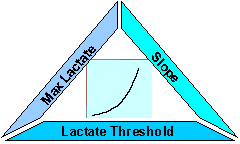
The lactate performance curve has three key elements. These are:
- the speed at the lactate threshold - This is usually determined
by a graduated exercise test. Very often coaches and sports physiologist will
substitute an easy to measure value for the lactate threshold such as the
speed at 4.0 mmol/l. This is not because they assume 4.0 mmol/l is the
lactate threshold but because it represents an easy point to measure. This
value is often close to the threshold value and represents the ability of
the athlete to perform aerobically. It is usually possible to compare one
athlete with another on this variable to see which is performing better
aerobically.
- the maximum lactate that can be generated - This value represent
the anaerobic component of an athlete's conditioning. Coaches should not
compare one athlete with another on this variable but it should be used for
each athlete to assess how much energy they are generating anaerobically.
This value should peak close to the main competition.
- the slope of the curve. - The slope of the curve is affected by several factors. Some of which are strength of the athlete, the distribution and adaptation of different types of fibers, technique or economy of movement and the test itself. For example, in the preceding example, shorter stages in the test produced a flatter curve. Usually athletes with a high percentage of slow twitch fibers will have a flatter curve. See the example of marathon runners versus sprinters in the Lactate Testing Basic Concepts section.
All three of these must be considered when assessing the performance potential of an athlete. Most discussions of lactate testing have focused on the first two parameters, but the third can be equally important. Generally, the speed at lactate threshold is most important for endurance athletes but for those events that take place in the 1-8 minute range, the other two factors become very important and sometimes will be pre-eminent. The following chart of a male swimmer illustrates the effect of all three parameters.
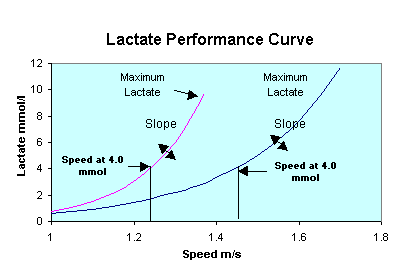
Plotted on the chart above are two lactate performance curves for a swimmer whose events are 100 and 200 meter freestyle. One (curve on the left) is from the beginning of the season and the second was measured just before a major competition. Notice that all the key parameters have improved. The speed at 4.0 mmol/l has increased from 1.25 m/s to 1.45 m/s. This is a very nice improvement and will affect the athlete's performance substantially. This chart uses the speed at 4.0 mmol/l of lactate and not the lactate threshold.
The second important parameter is the maximum lactate value. Again the improvement will affect performance but not as much as the improvement in speed at 4.0 mmol/l. In a race, every tenth of a second counts. The third parameter, slope of the curve, has also improved in a positive fashion. What this means is that the swimmer can go at a faster speed before he reaches his maximum lactate value. So any flattening of the slope of the curve will improve performance if the other parameters remain the same. Some coaches and sports physiologists have pointed to the inter-relation of these three parameters as the key to success in many sports. The important thing is how to train the athlete so that these three parameters can be maximized since the training to improve one may be detrimental to the improvement of the other.
For English reading visitors, there is much more on lactate testing at other parts of the site.
Home Page |Lactate Plus | Lactate Scout | Triathlon | Thresholds | CD-ROM
For Portuguese Reading visitors the following links are some additional links
Alto da Página | Página principal | Página principal en Español | English Home Page
A Fisiologia do Lactato e o Treinamento Esportivo
- Seção 1 - Terminologia e Conceitos Básicos.
- Seção 2 - Lactato e o Limiar para o Treinamento.
- Seção 3 - Razões para Utilizar a Análise de Lactato. (em Inglês)
- Seção 4 - O Lactato e os Sistemas Energéticos. (em Inglês)
- Seção 5 - A Produção e a Remoção do Lactato, e o Treinamento de Resistência. (em Inglês)
- Freqüência Cardíaca e o Lactato.